
5 Enterprise AI Changes to Watch in 2027: Moving from Adoption to Accountability
Explore 5 key enterprise AI trends for 2027—from dynamic context layers and agent identity to verification debt and operational workflow fit.
Key Takeaway (TL;DR):
Heading into 2027, enterprise AI is shifting from speculative capability to operational governance. Based on late-2026 outlooks from Gartner and Forrester, business leaders are no longer asking “what can the model do?” but “can we trust what it acts on?” The five defining shifts are:
- Dynamic context layers that keep pace with real-time internal policy updates.
- Graceful failure handling that halts execution before errors compound.
- AI agent identity governance (IAM) with strict permission boundaries.
- Accounting for verification debt—the human cost of checking AI drafts.
- Purpose-built workflow integration inside the weekly operating cadence.
A wrong answer is especially frustrating when it sounds completely confident. When that error touches your company’s leave policy, client commitments, or compliance filings, someone on your team has to catch it before it turns into operational damage.
That practical friction sits at the heart of our five enterprise AI expectations for 2027. Drawn from analyst research and industry trends published through late 2026—including Gartner’s strategic tech outlook and Forrester’s enterprise predictions—here is what the next wave of AI maturity means for leaders evaluating, buying, and deploying AI workflows.
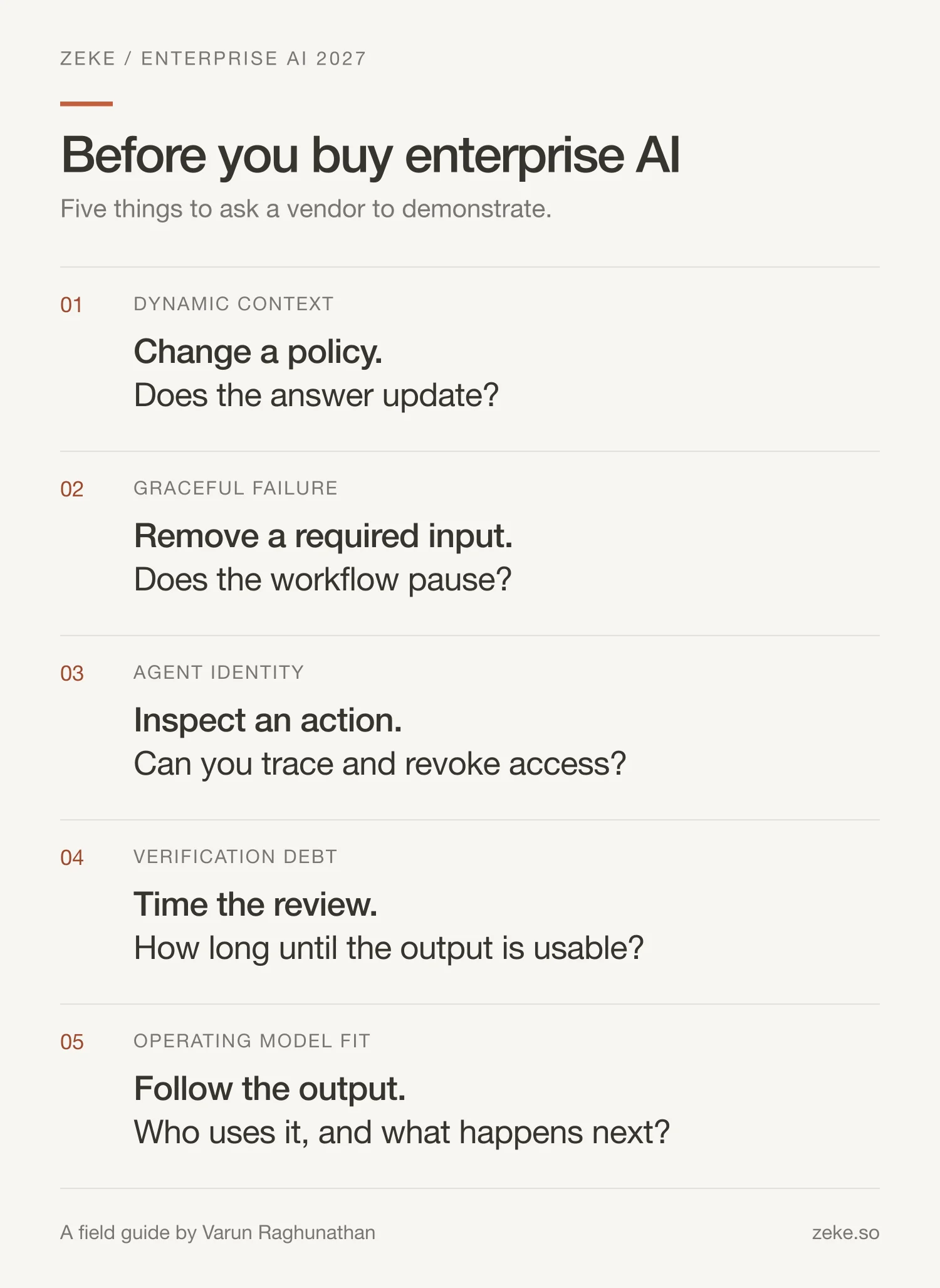
1. Dynamic Context: Answers That Adapt When Policies Change
An AI response grounded in an outdated policy document sounds just as convincing as one referencing yesterday’s update. As knowledge bases expand, static retrieval (RAG) fails whenever internal rules change faster than vector stores are re-indexed.
- What is changing: In 2027, buyers are prioritizing dedicated AI context platforms—semantic layers that connect agents to live, single-source-of-truth business rules.
- The Buyer’s Test: Change a policy clause in a test environment, then ask the AI assistant the same question immediately. Does it surface the updated standard with a clear citation, or does it hallucinate cached guidelines? If your existing knowledge architecture already handles dynamic policy updates, you don't need a replacement; you need consistency.
2. Graceful Failure: Pausing Before Errors Compound
When an AI assistant or autonomous workflow gets stuck, guessing is the worst possible outcome. Hallucinating an answer turns a single missing variable into cascading data cleanup.
- What is changing: Reliability engineering is replacing raw prompt experimentation. Modern autonomous workflows are judged on their ability to stop, signal missing inputs, and loop in a human supervisor rather than forcing an ungrounded conclusion.
- The Buyer’s Test: Ask vendors to demonstrate a failed task, not just a smooth demo. When client billing records or project deadlines are missing, does the system flag the gap and escalate, or does it guess and proceed? How an AI system handles edge cases tells you how much corrective work your team will inherit.
3. Agent Identity & Least-Privilege Action Limits
Drafting an outbound client email and hitting "Send" carry vastly different levels of business risk. The executive approving the tool must know where the boundaries lie.
- What is changing: As agents transition from passive copilots to autonomous actors, AI Agent Identity and Access Management (IAM) has become a board-level priority. System credentials must transition from static API keys to temporary, policy-bounded permissions.
- The Buyer’s Test: Demand visibility into access control and audit trails. Which agent touched the customer record? Who authorized the write-access? Can access be instantly revoked when a run concludes? Never accept sales promises on safety—verify granular, human-in-the-loop permission limits before granting read/write system access.
4. Accounting for "Verification Debt": The True Cost of Checking Work
A 10-second draft is no bargain if an engineer, marketer, or legal lead spends 45 minutes verifying its citations, catching subtle inaccuracies, and adjusting the tone.
- What is changing: Procurement teams are factoring in Verification Debt—the human labor required to audit, correct, and certify AI-generated assets before production.
- The Buyer’s Test: Calculate total cost of ownership (TCO) not just by software seat licenses or token costs, but by total time to final output. If an automated workflow requires two rounds of peer review to trust the output, a streamlined, deterministic workflow or specialized lightweight tool is often far more cost-effective.
5. Operating Model Fit: Establishing Where AI Sits in the Working Week
Microsoft’s Work Trend Index revealed an ongoing paradox: organizations adding AI tools without redesigning how work flows rarely see sustained productivity gains.
- What is changing: Buying AI is no longer a technology procurement task; it is an operating model adjustment. Teams are defining explicit operational handoffs: who triggers the agent, who reviews exceptions, who acts on the synthesis, and which legacy status meetings get eliminated as a result.
- The Buyer’s Test: Before rolling out another assistant, audit the end-to-end task. An AI-generated weekly status update that nobody has time to read is just inbox noise. Define the consumer and the downstream action before deploying the generator.
Practical Next Step: Start with an Interruption Audit
You don’t need to overhaul your entire technology stack to prepare for 2027.
Look at your team’s last month: Where did bad information or repetitive context-switching derail half a workday? Pick that single, high-friction workflow and evaluate AI solutions strictly against failure recovery, auditability, and review time.
If your current tools already solve the problem reliably, keep them. If you’re trying to determine which workflow to automate safely first, talk through one weekly task with Zeke.